In the middle of summer 2024, the song “10 Drunk Cigarettes” became a TikTok sensation. This was the height of Brat Summer - a time when women like Charli xcx and Sabrina Carpenter were dominating the pop industry, chartreuse was the colour of the moment, and tobacco use (and that of various illicit substances) was a common theme in top records. It was in this moment that Girly Girl Productions released their soon-to-be-viral track - a high-energy song in which the vocals describe various things they would prefer to a man, including:
One new vape, two lines of coke / Three drinks from the bar, four more lines of coke / Five Guys fries, six hits of my blunt / Seven more lines of coke, eight pairs of shoes / Nine BB belts and ten drunk cigarettes.
For many people, "10 Drunk Cigarettes" was their first introduction to music created with the use of artificial intelligence. In the years since, AI music has gained a significant foothold in Spotify and other music streamers. 44% of all new uploads on Deezer are AI-generated, according to the French streamer. In April 2026, ‘Celebrate Me,’ released by AI persona IngaRose, reached the top of the iTunes charts in the US, UK, France, Canada, and New Zealand. Created using the AI music generator Suno, the track has featured in nearly 300,000 TikTok videos – fuelling widespread debate across the music industry. This rapid rise has triggered a broad spectrum of concerns, from copyright infringement and artist impersonation to deeper unease about outsourcing music-making - long considered one of humanity’s most universal and expressive art forms - to non-human systems.
Even Ireland – with its deep tradition of (human) singer-songwriters – is not immune to the proliferation of AI-generated music. District Magazine points to a growing cohort of AI-generated “artists,” such as Sonara and Delta Ash, who draw on stylised notions of Irish identity to produce content. Much of this output consists of reimagined versions of well-known songs - like Bob Dylan’s “Knockin’ on Heaven’s Door,” Michael Jackson’s “Billie Jean,” and blink-182’s “All the Small Things” - rendered in a traditional Irish style. The effect is that of a cover artist one might hear singing in a pub: familiar and technically competent – though notably enhanced with unusually sophisticated instrumentation and backing vocals.
AI artist Giddymethat has taken a more political approach, creating music that directly references hot-button issues of the day, including the April 2026 fuel protests and the ensuing No Confidence vote, the €336k Dáil bike shelter, the Mercosur deal, and former Taoiseach Leo Varadkar’s controversial comments to Matt Cooper on the Path to Power podcast. In just one month of activity, Giddymethat has racked up 35.4 thousand monthly listeners on Spotify and over 100,000 views on YouTube. Comments on YouTube posts show support for the songs’ messages, with users expressing a desire for an “Ireland for the Irish” and frustration with supranational organisations. Despite the songs’ Ireland-centric themes, many of the comments came from outside Ireland, particularly from German-speaking regions.
Giddymethat's Spotify artist photo, which tells of being generated with AI
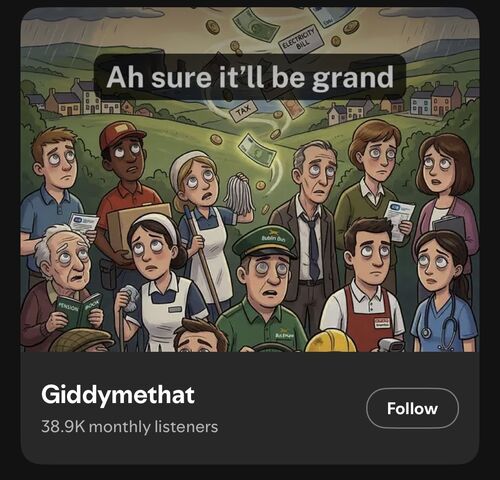
Giddymethat’s catalogue reflects a right-wing worldview, particularly around anti-globalism and anti-immigration. Across multiple tracks, global institutions - especially the EU - are portrayed as extractive and illegitimate, with the Irish government complicit in this abuse. In “Sure It’ll Be Grand,” lines such as “We sold our souls to Europeans” and “The Irish lost, the EU won” construct a zero-sum view of sovereignty, where participation in supranational governance is framed as national betrayal. Climate policy is a frequent punching bag, depicted not as a collective response to environmental crisis but as an imposition that disproportionately harms the “workin’ man,” reinforcing a populist narrative of elites versus ordinary citizens.
Anti-immigration sentiment is even more explicit. “Vote of No Confidence” invokes the language of “replacement” (“Youth immigration now foreign replace”), echoing widely circulated far-right conspiracy framings. Elsewhere, migrants are cast as opportunistic rather than vulnerable, with lines suggesting they are “flying toward free money” rather than fleeing conflict. This is paired with a rhetorical strategy that anticipates and dismisses criticism - claiming that any objection will be labelled “right wing” or “racist” - thereby positioning the artist (and listener) as unfairly censored truth-tellers.
In “Through the Rural Mud,” these themes are interwoven with cultural and identity politics. The track opens with gendered attacks on political figures, framing them as insufficiently masculine, before veering into a thinly veiled reference to Varadkar’s sexuality. It also criticises state spending on IPAS centres and accommodation for refugees, particularly those arriving from Ukraine, reinforcing a narrative of misplaced national priorities.
Taken together, the lyrics articulate a worldview grounded in cultural protectionism, scepticism of international cooperation, and hostility toward immigration - framed through a distinctly Irish lens but closely mirroring broader right-wing discourses seen across Europe and beyond.
There is nothing inherently problematic about political music. Many of history’s most influential artists - including Bob Dylan, Sam Cooke, Sinead O’Connor, and the Cranberries - have used their work to engage with contentious social and political issues. The distinction here lies not in the presence of politics, but in the conditions under which this music is being produced and circulated.
AI-generated music lowers the barriers to entry in a way that fundamentally alters the landscape. Where traditional music ecosystems involved some degree of gatekeeping - through labels, producers, audiences, or simply the need for a baseline level of talent - AI tools allow anyone to rapidly generate and distribute content at scale. This creates an additional channel through which harmful or polarising rhetoric can be amplified, often without the friction that might otherwise challenge or contextualise it.
The pace of production is another key shift. Artists like Giddymethat are able to release large volumes of content in a short period of time, enabling them to quickly respond to political developments, test messaging, and saturate platforms. This speed makes it harder for listeners, platforms, or regulators to keep up, and can contribute to the rapid normalisation of particular narratives.
Finally, there is the issue of transparency. Listeners are not always aware that what they are hearing is AI-generated, nor how it has been created, what data it has been trained on, or who is ultimately behind it. Spotify has launched a feature allowing artists to disclose their use of AI, but the system is voluntary and unlikely to stem the rising tide of AI artists. This opacity complicates questions of accountability and intent, particularly when the content engages with sensitive or divisive political themes.
In a political environment plagued by deepfakes, automated propaganda networks, and algorithmically targeted misinformation, Giddymethat's AI music is yet another example of how emerging technologies can accelerate the spread of far-right messaging. Streamers must take a more active role in labelling AI-generated music – ensuring that content producers like Giddymethat, Sonara, and Delta Ash cannot hide behind human personas or use synthetic identities to evade scrutiny. Greater transparency is essential if platforms are serious about limiting the reach of extremist propaganda disguised as entertainment.
Molly Newell

Molly Newell leads TASC’s research on a variety of emerging tech issues, including AI, cybersecurity, digital regulation, and platform economies. An experienced project manager, Molly has led research teams analysing technology, cybersecurity, and security policy. She holds an MSc in Digital Policy from University College Dublin and a BA in Public Policy & Leadership from the University of Virginia.
Share:


