In March, global data centre and colocation provider Equinix announced construction of a new data centre in Dublin’s Blanchardstown neighbourhood (Equinix, 2026). The DB7x facility will sit next to two other Equinix locations, DB5x and DB6x, adding to a growing hub of data centres in the area. Blanchardstown is not unique in this regard, but it offers a particularly stark illustration of a broader trend: large-scale digital infrastructure being sited in areas with lower incomes, higher unemployment, and fewer resources.
What is striking is not just that deprived areas host some data centres: it is that they host almost all of them.
Nearly 90% of Dublin’s data centres are located in economically-deprived areas. This is not an incidental pattern or a quirk of urban planning - it is a defining feature of how Ireland’s digital infrastructure has developed. Rather than being evenly distributed across the city or concentrated in already-affluent business districts, data centres are overwhelmingly clustered in communities that already face structural economic disadvantage.
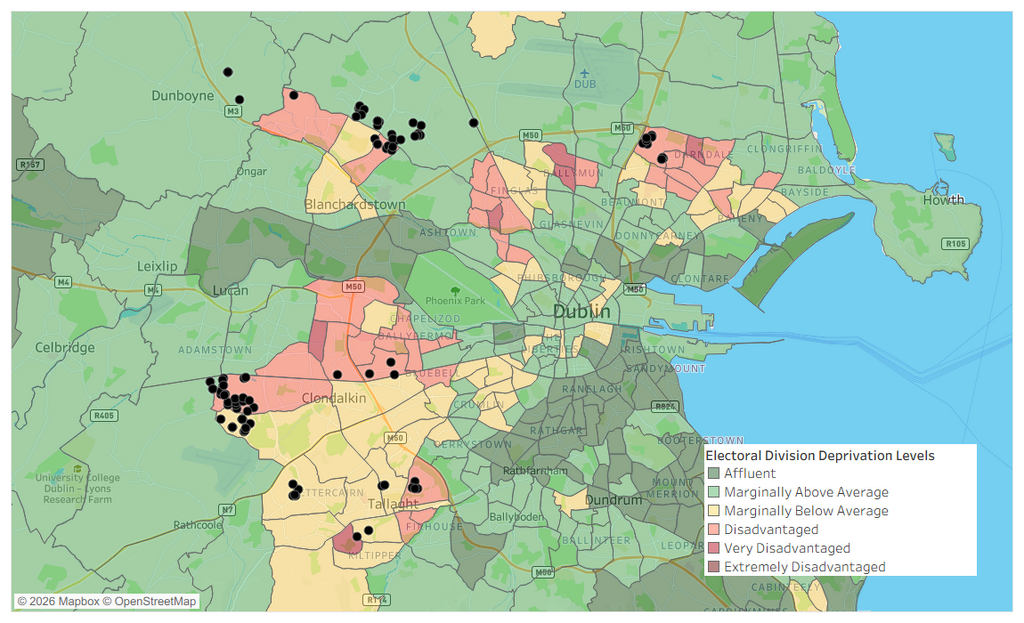
Figure 1: Location of Dublin-area Data Centres and Pobal economic deprivation
Understanding Ireland’s Data Centre Landscape
Ireland – and Dublin in particular – has become one of Europe’s leading data centre hubs, hosting an estimated 127 active or planned data centre buildings and campuses – a staggering number given Ireland’s relatively small population (Data Center Map, 2026). The number of data centres in Ireland per capita is 10 times higher than the European average (Sustainable Energy Authority of Ireland, 2025).
This growth is closely tied to Ireland’s broader technology sector, which plays a critical role in the national economy and positions the country as one of Europe’s leading digital hubs. Since the 1990s, Ireland has pursued a deliberate strategy to attract foreign direct investment, anchored by a low corporate tax rate and a suite of incentives for research and development. These policies, combined with EU market access and a highly educated, English-speaking workforce, have attracted major multinational firms across software, cloud computing, social media, and financial technology (IIEA, 2025).
Today, 16 of the world’s 20 largest tech firms have a significant presence in Ireland (IDA Ireland, 2025). In 2022, the Irish ICT sector represented 34.8% of the gross value added - by far the highest share in the EU (European Commission, 2025). Data centres themselves are a significant contributor, estimated to have added €7.3 billion to the Irish economy (Trinity Centre for Digital Business and Analytics, 2025), with further growth expected as demand for cloud computing and artificial intelligence continues to expand. On a European level, there is strong momentum to expand the bloc’s AI capacity through the expansion of digital infrastructure (Politico, 2026).
However, the benefits of the digital economy have been concentrated – both geographically, in and around Dublin, and structurally, among a relatively small number of large firms. In 2024, almost half of the Corporation Tax collected by the State was paid by three multinational – two of which are tech firms (RTE, 2026).
Spatial Inequality in Dublin’s Data Centre Locations
The wealth of these data centre operators contrasts sharply with the communities hosting their infrastructure. Despite its status as one of Dublin’s largest suburbs, portions of Blanchardstown face significant economic deprivation, according to the Pobal HP Deprivation Index. Neighbourhoods such as Blanchardstown-Corduff and Blanchardstown-Tyrrelstown are classified as disadvantaged and experience higher levels of unemployment and lower levels of educational attainment than both the Dublin average and nearby areas like Fingal (Pobal, 2023; Fingal County Council, 2023).
To better understand the placement of data centres in relation to economic deprivation, TASC examined the locations of 97 active or planned data centre buildings across the greater Dublin area alongside measures of local socio-economic conditions. Using the Pobal HP Deprivation Index - which classifies small areas based on indicators such as employment, education, and household composition - we find that 84 out of 97 data centre buildings are located in areas classified as marginally below average, disadvantaged, or very disadvantaged (See Figure 2; Table 1). Clusters of data centres have emerged in Blanchardstown, Tallaght, and Clondalkin - areas that consistently rank below the national average on key socio-economic indicators.
Figure 2: Number of data centre buildings in the greater Dublin area, by small area Pobal economic deprivation status
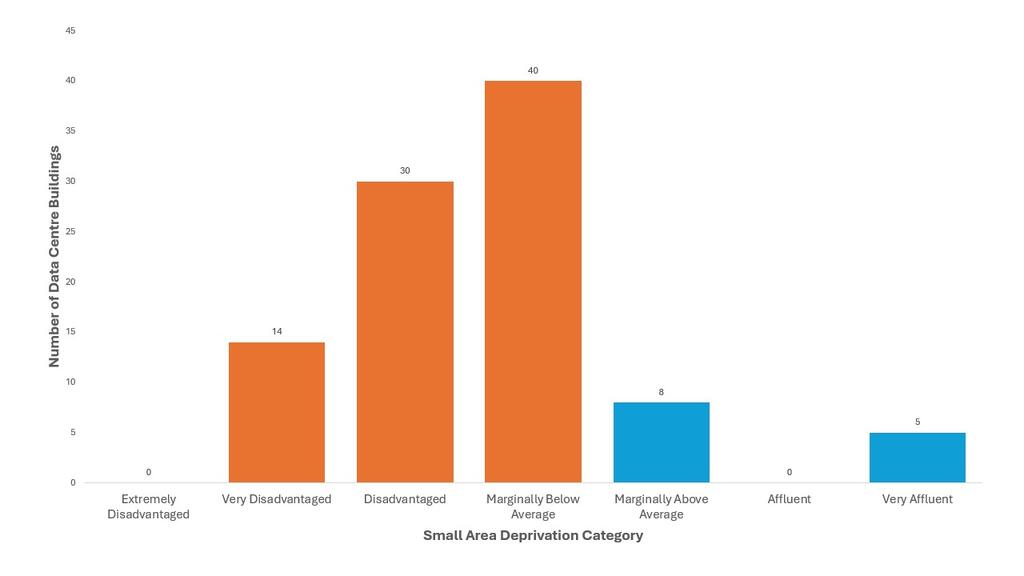
Table 1: Small Area Analysis
Small Area ID | ED Name | Small Area Pobal HP Description 2022 | Building Count |
257003005/01 | Arklow Rural | Marginally Below Average | 1 |
267030012 | Blanchardstown-corduff | Very Disadvantaged | 7 |
267032011 | Blanchardstown-mulhuddart | Disadvantaged | 1 |
267034001/01 | Blanchardstown-tyrrelstown | Marginally Above Average | 1 |
268040005 | Cherry Orchard C | Marginally Below Average | 3 |
267053001/02 | Clondalkin Village | Marginally Below Average | 11 |
267049001 | Clondalkin-dunawley | Marginally Below Average | 20 |
267051001 | Clondalkin-moorfield | Disadvantaged | 1 |
167029015 | Dunboyne | Marginally Above Average | 5 |
257047001 | Kilbride | Marginally Below Average | 1 |
267107005/01 | Newcastle | Very Disadvantaged | 2 |
268121002 | Priorswood A | Disadvantaged | 9 |
267138002/01 | Tallaght-fettercairn | Very Affluent | 5 |
267144002 | Tallaght-kingswood | Marginally Below Average | 2 |
267146005 | Tallaght-oldbawn | Marginally Below Average | 2 |
267148002 | Tallaght-tymon | Very Disadvantaged | 5 |
267158012/07 | The Ward | Disadvantaged | 19 |
267158009/02 | Marginally Above Average | 2 |
Even in cases where a broader electoral division appears relatively average or above average, the specific small areas hosting data centres are often among the most deprived within those districts. In the Ward, for example, which is marginally above average, most facilities are located in disadvantaged pockets bordering very disadvantaged areas in Blanchardstown.
This concentration reveals a clear spatial inequality: the infrastructure underpinning the global digital economy is being embedded in communities that are already economically marginalised. While these developments are often framed as engines of local growth, their geographic distribution suggests a different reality - one where the burdens and benefits of the digital economy are unevenly shared.
The business logic behind this pattern is unsurprising. Economically-deprived areas offer relatively affordable land, making them attractive for large-scale, land-intensive developments. They are also typically located on the periphery of the city, where access to power and fibre infrastructure can be secured without the constraints of dense urban environments.
Supporters of data centres often argue that these facilities will bring jobs to local communities - jobs that could help address persistently higher unemployment rates (Amazon, 2023). There is some truth to this during the construction phase, which can generate short-term employment. However, Ireland’s construction sector is already experiencing labour shortages, meaning that new data centre projects may simply intensify competition for workers, drive up costs, and crowd out other forms of development, particularly housing (Houses of the Oireachtas, 2025).
Once operational, data centres generate relatively few permanent jobs. Despite their enormous physical footprint, they are highly automated environments, typically employing only a few dozen staff (Wall Street Journal, 2025). Many of these roles require specialised technical skills or advanced education, limiting their accessibility to residents in disadvantaged areas (IEEE, 2026).
At the same time, the massive quantities of electricity they consume have system-wide implications. In 2024, data centres accounted for 22% of Ireland’s total electricity demand, according to the Central Statistics Office, and this share is projected to rise significantly in the coming decade (CSO, 2025). In Dublin and neighbouring County Meath - where Meta operates large facilities - data centres already consume around 50% of metered electricity (RTE, 2026). Recent decisions by the Commission for Regulation of Utilities to permit new grid connections are likely to intensify this demand. While these rules require data centres to source 80% of their electricity from renewables and eventually supply power back into the grid, they also allow facilities to run entirely on fossil fuels for their first six years and permit the remaining 20% of energy to come from gas or diesel. Alongside requirements for on-site backup generators - typically powered by fossil fuels - this framework risks locking in higher emissions and further straining an already constrained electricity system (RTE, 2026).
Taken together, this raises important questions about who truly benefits from Ireland’s data centre boom. While multinational technology firms generate substantial revenues and contribute to national tax receipts, the communities hosting this infrastructure see limited direct gains. Instead, they bear the spatial and environmental footprint of an industry whose economic benefits are distributed elsewhere.
The fact that nearly 90% of Dublin’s data centres are located in economically deprived areas is not just a statistic: it is evidence of a broader imbalance in how the digital economy is embedded within the city.
This research was supported by the European Artificial Intelligence & Society Fund.
Molly Newell

Molly Newell leads TASC’s research on a variety of emerging tech issues, including AI, cybersecurity, digital regulation, and platform economies. An experienced project manager, Molly has led research teams analysing technology, cybersecurity, and security policy. She holds an MSc in Digital Policy from University College Dublin and a BA in Public Policy & Leadership from the University of Virginia.
Share:


