The People’s Transition in the Uíbh Ráthach Gaeltacht (English)
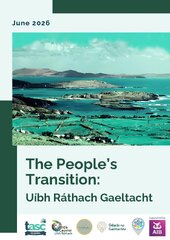
The People’s Transition is a participative decision-making model for climate action. It views climate action as an enabler of local development, giving people and communities ownership of the transition to zero-carbon societies. The People’s Transition seeks to deliver a bottom-up approach to transition that builds local wealth, enables local ownership of climate action and empowers local people.
Inside the People’s Transition in the Uíbh Ráthach Gaeltacht
The People’s Transition in the Uíbh Ráthach Gaeltacht began in February 2024. The intention of the project was to listen to and learn from the community’s needs and abilities and then design climate solutions that would benefit the community while addressing key local development priorities. The project had three phases: a mapping phase, a community engagement phase, and a solutions phase. Through research, stakeholder engagement, and participatory arts residencies developed in partnership with Cumas Ceantar Uíbh Ráthach, the project identified the rural housing crisis as a central challenge facing the Gaeltacht.
The report outlines three strategic pathways to support a just transition, including a community-led housing pilot, enabling policy measures for affordable housing, and the development of a community-led just transition housing network. Together, these pathways present a vision for climate action that strengthens housing, sustains language and culture, supports local livelihoods, and builds long-term community resilience.
MAPPING
The mapping phase aimed to build a picture of the Uíbh Ráthach Gaeltacht, outlining a geographical scope for the project that reflects the people and communities living there. This phase focused on understanding the area’s demographic, social, economic, and cultural context, as well as the distribution of key institutions, services, and community organisations that play an important role in local life. Through analysis of existing research, local development plans, and preliminary stakeholder engagement, the project identified major challenges and opportunities in the area, with the shortage of accessible and affordable long-term housing emerging as a key priority.
COMMUNITY ENGAGEMENT
The community engagement phase built on the initial mapping process and was developed in partnership with Cumas Ceantar Uíbh Ráthach. During this stage, TASC engaged with local residents, community groups, development workers, students, and other stakeholders to better understand lived experiences, priorities, and aspirations for the future. A key part of this phase was the TOCHAIL socially engaged arts residencies, which brought artists and community members together to explore the housing crisis through the lens of climate justice. Using workshops, conversations, and creative methods, the engagement process created space for inclusive participation and helped surface community-led ideas for a fairer and more sustainable future.
CO-CREATION OF SOLUTIONS
Building on the mapping and community engagement phases, TASC worked with local experts and community members to co-create practical climate solutions that respond to local needs and build on existing strengths. Through collective reflection and deliberation, three strategic pathways were identified:
- Integrating just transition principles into a community-led housing pilot
- Creating a supportive policy environment for affordable housing
- Developing a community-led housing network across the Gaeltacht.
These pathways present a shared vision for climate action that strengthens housing, supports language and culture, promotes local livelihoods, and builds long-term resilience.