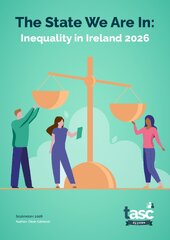
The State We Are In - Inequality in Ireland 2026
Researchers at TASC have now been studying inequality for a quarter of a century. Throughout that period, economic inequality and democratic accountability have remained at the centre of the organisation’s work. TASC has sought not only to document inequality in Ireland, but also to understand the institutions and economic structures that produce it and to develop policies capable of creating a more equal society. TASC’s annual inequality reports have extended beyond a general analysis of economic inequality to examine particular dimensions of inequality. At the same time, these reports have continued to provide a general analysis and regular update on inequality in Ireland.
The report, The State We Are In - Inequality in Ireland 2026, has three core chapters exploring three sets of things. Firstly, it looks back over 25 years of research, secondly, it examines the current state of inequality in Ireland and, thirdly, it considers how artificial intelligence may affect existing economic and social inequalities. This year’s report highlights how Ireland’s tax and welfare system prioritises compensating for inequality after it occurs, rather than addressing the root cause. This causes significant pressures on household living standards, despite headline inequality indicators saying otherwise. As AI looks set to reshape the economy, Ireland has the opportunity to properly allocate its gains from the outset.
While nominal income is rising substantially, median household disposable income is being eroded by inflation, having increased by just €504 between 2022 and 2025. Social transfers continue playing a central role in supporting lower-income households, accounting for 79% of net disposable income for the lowest income decile. Additionally, 17,482 people were living in local authority-managed emergency accommodation in June 2026, including 5,620 children – a 437% increase since 2014. These findings demonstrate the need to tackle inequality at its source.
An estimated 63% of jobs in Ireland are currently exposed to AI. Roughly 30% face a comparatively high risk of displacement, while about one-third are considered well positioned to benefit from AI. Without intervention, the income lost through displacement is likely to outweigh any gains, reducing average household disposable income and producing a moderate increase in inequality. TASC says the response to AI must therefore go beyond simply preparing people to use the technology. Upskilling and retraining will be critical in addressing gaps in digital readiness and preparing displaced workers for new roles, but this cannot be treated as a complete solution. The task is not only to prepare workers for disruption, but to build an economy that gives workers a voice and prioritises equality.
The report calls for digital literacy that develops the critical capacity to understand and challenge AI, policies to ensure the broad distribution of benefits, and action that gives workers a meaningful voice in transformation agendas.
Dr Shana Cohen, TASC Executive Director said: “When TASC was first established 25 years ago, inequality and democratic accountability were identified as central themes of our work, and they remain inseparable today as we enter this new era of transformation. “AI is not an inevitable force that Ireland simply has to adapt to. We have choices about how it's introduced, and we should be ambitious about the kind of future we want those choices to create.”
Oisín Gilmore, TASC Senior Economist and report author said: “The apparent stability of Ireland’s headline inequality indicators conceals significant pressures on household living standards. TASC’s research has consistently argued for greater attention to ‘predistribution’, by tackling inequality at its source. “Ireland’s current approach to reduce inequality after it occurs is no substitute for strengthened workers’ rights, a more equal distribution of wealth, and stronger public services. As we enter this new era of AI, the lessons of the past 25 years show the importance of taking action early to shape how its benefits and costs are distributed.”
Molly Newell, TASC Technology Researcher and report contributor said: “Dominant government and business narratives claim that AI ‘promises’ to boost productivity and grow the economy, but deliberate action is needed to ensure that this growth is shared more widely.
‘Disruptive’ technologies can’t disrupt entrenched patterns of inequality on their own. To ensure that AI can support a more just society, policymakers must consult more diverse voices and consider the social and environmental risks of digital transformation more deeply. As TASC embarks on its next 25 years, we will continue exploring how emerging technologies can be shaped to support a fairer and more inclusive society.”
Read "Section A: Twenty five years of TASC addressing inequality" here
Read "Section B: Inequality in Ireland 2026" here
Read "Section C: AI & Inequality Section" here